Once you know the cash positions, you can proceed with the balancing of the accounts through the Management tasks of Cash. This type of balancing enables you to avoid leaving credit balances unpaid while paying premiums on accounts with a debit status.
For this purpose, you can access the available balances view and, from it, initiate one of the two account balancing processes:
- Automatic Balancing, with auto-generated propositions. This process generates bank-to-bank transfers on accounts with the same currency.
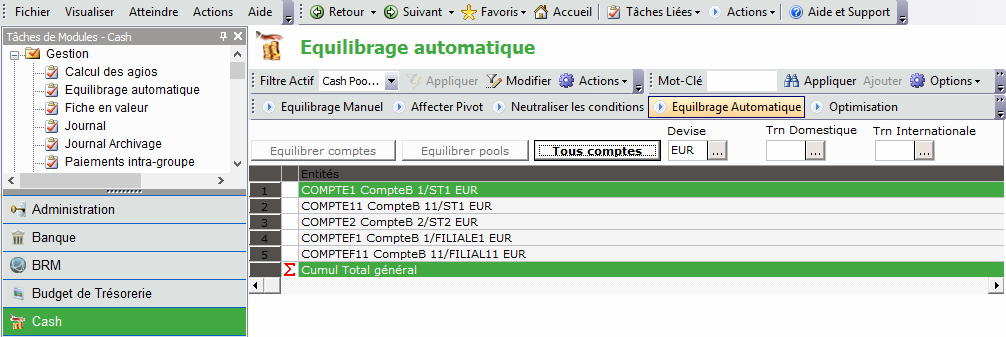
- Manual Balancing, for which you choose the transfers to be performed. This process provides you with a real-time view of the impact on balances for selected the accounts.
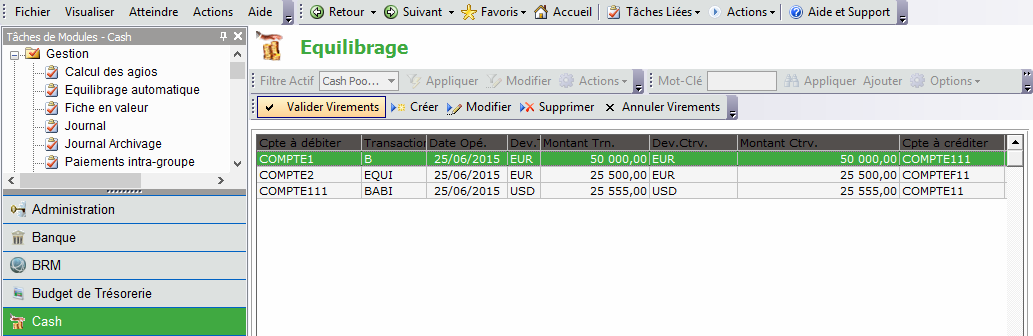
Cash module enables you to manage automatic balancing processes such as:
- Cash pooling, which means keeping your account balances to zero, a specific amount or within a defined range.
- Optimization, which means reducing overall bank costs.
Info
Cash takes into account the rolling conditions for bank-to-bank transfers which are specific to balancing functions, defined in Setup.
The automatic Cash Pooling transfers can be performed on accounts with different currencies. So, the generated cash flows may be domestic bank-to-bank transfers, foreign bank-to-bank transfers (between accounts with different In currencies) or currency buys/sells.
Generally speaking, Automatic Cash Pooling is used when the company has an overall credit or debit position to centralize excess cash or financing needs on the bank with which an investing/financing transaction has been set up.
If the available balances indicate that the company's overall position is near zero, but that certain accounts are in credit and others in debit, then the Optimization function can be used to reduce the bank costs.


